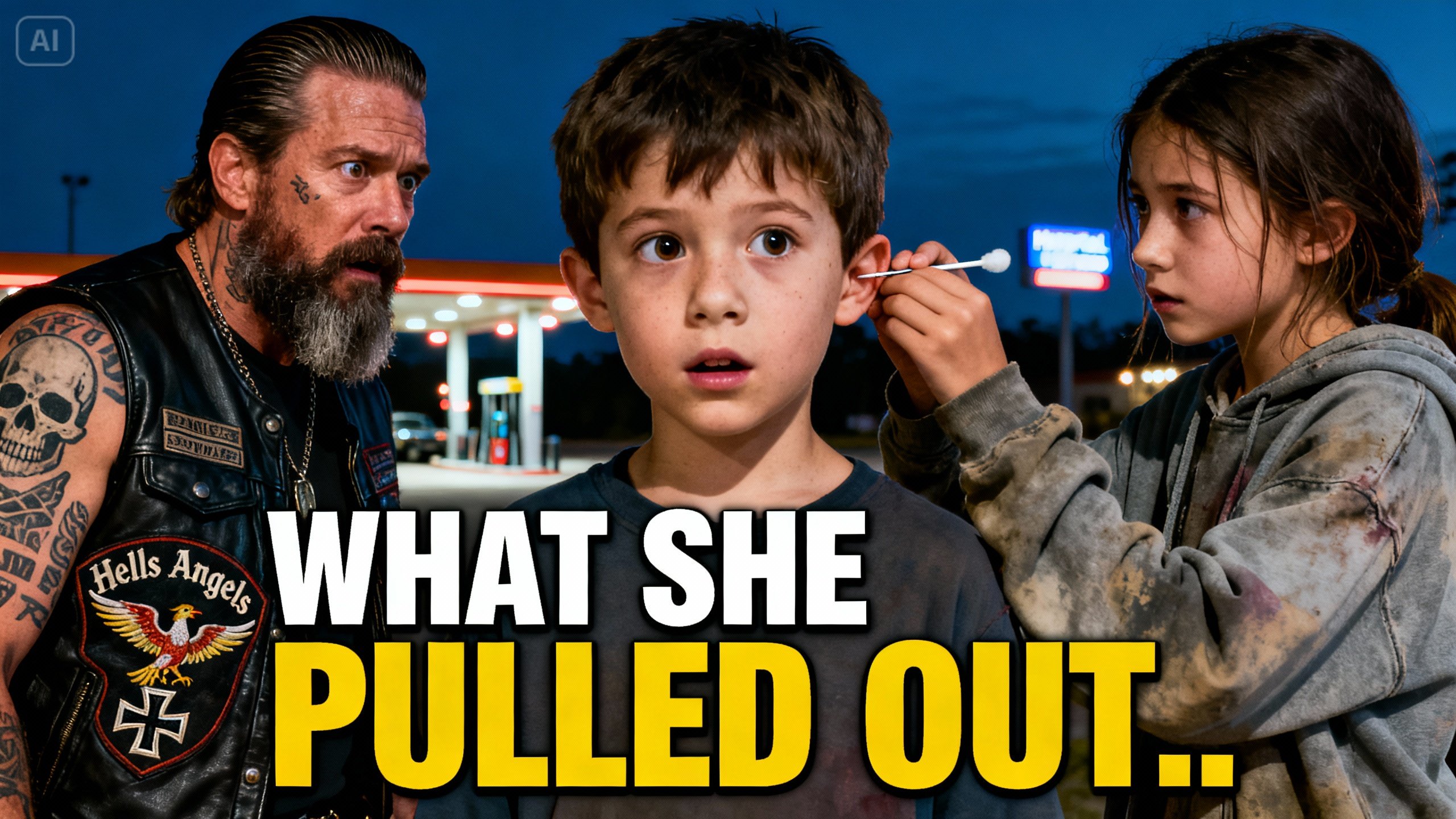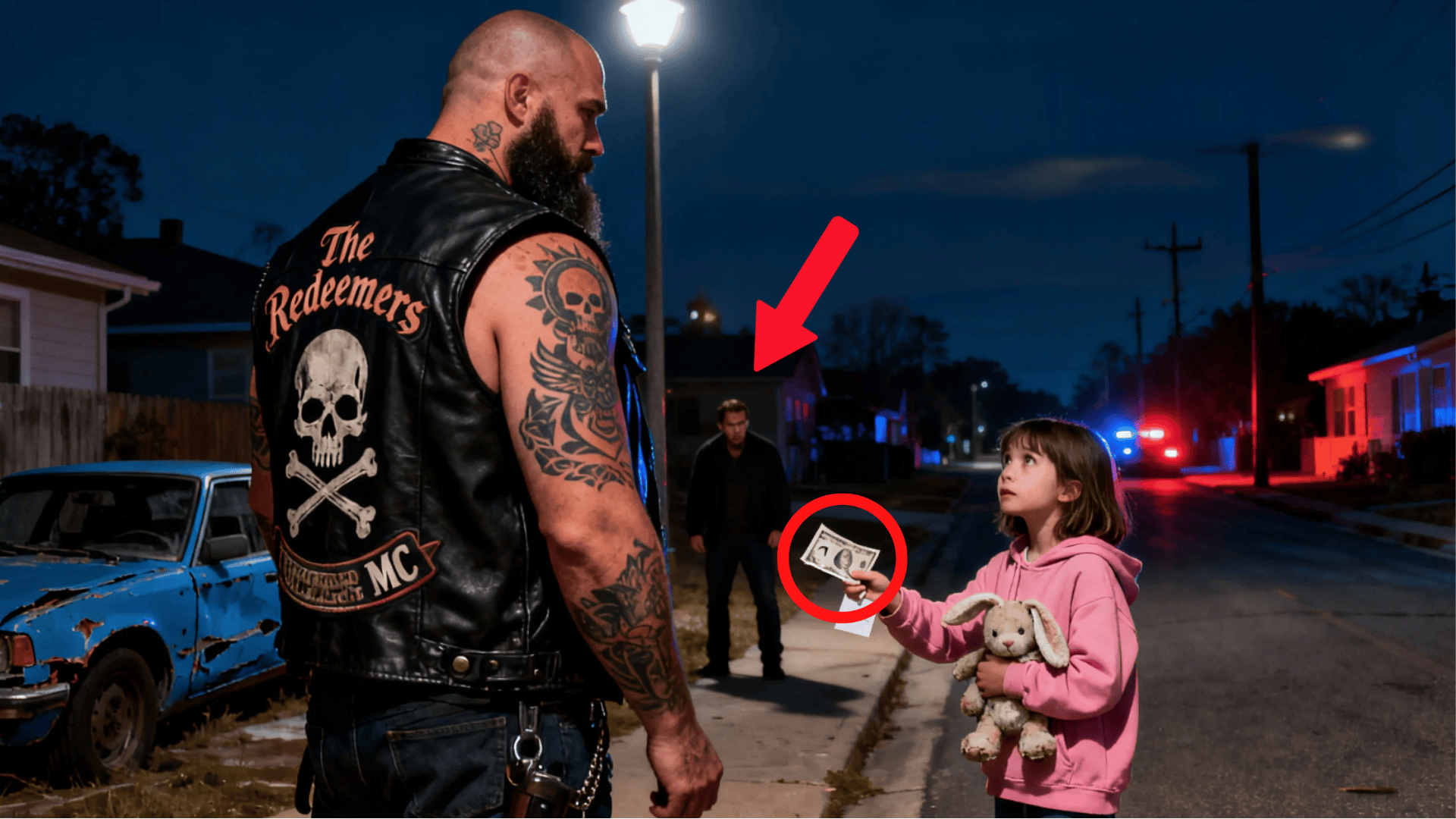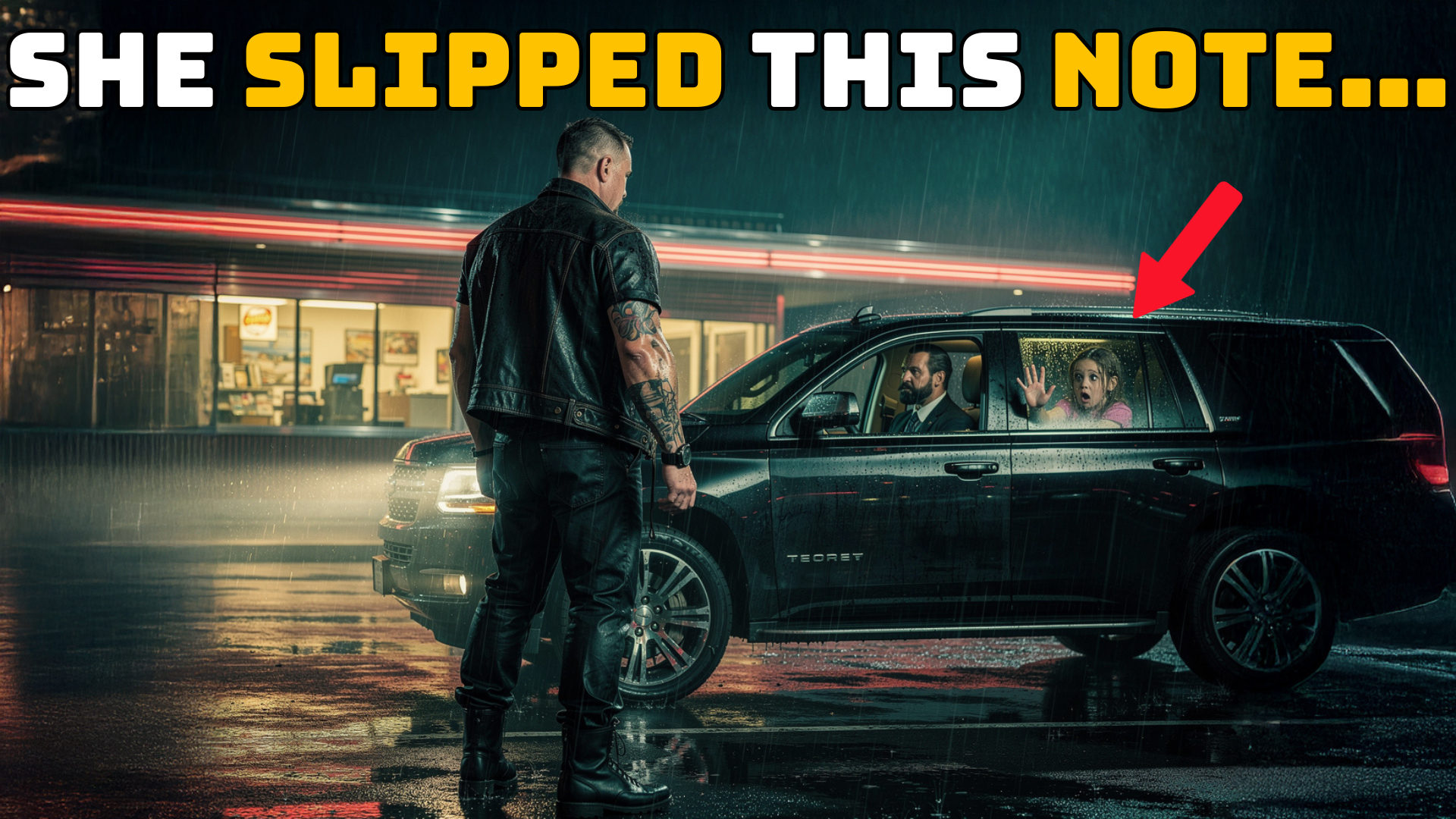
She Slips A Hidden Note… Hells Angels Biker Realizes This Family Is In Serious Danger
The road has a language of its own. It speaks in the hum of tires on wet asphalt, in the roar of a V-twin engine, and in the silence of the spaces between towns. For those of us in The Redeemers Motorcycle Club, the road is our church, and the leather on our backs is our vestment. We are often looked at with fear. We see the mothers pull their children closer in the grocery store aisles. We see the car doors lock as we filter through traffic. We understand it. We are big men. We are loud men. We carry the ink of our pasts on our skin and the grit of the highway in our beards. But appearance is the greatest liar of them all. Because underneath the skulls and the denim, behind the walls of noise we create, beats the heart of a protector. We are the sheepdogs in wolf’s clothing. And sometimes, the wolf shows up wearing a three-piece suit. It was a Tuesday, late afternoon. The sky had bruised over with that deep, angry purple that promises a storm, forcing us off the interstate and into a diner called "Sal’s" just outside the county line. There were six of us. Myself, Bear—the President of this chapter—and my brothers. And then there was Tiny. Now, Tiny is a misnomer. The man is six-foot-seven, built like a refrigerator filled with concrete, with hands the size of shovels. He looks like the kind of man who tears phone books in half for fun. But Tiny? Tiny was currently arguing with the waitress about whether the apple pie had enough cinnamon, a childlike grin plastered across his face. We were loud. We were happy. We were safe in our brotherhood. But just across the aisle, in the booth adjacent to ours, the air was different. It was cold. Stagnant. While we laughed, they sat in a silence so heavy it felt like it had mass. There was a man—sharp suit, expensive watch, hair gelled back with precision. He looked like a banker, or a lawyer, someone society tells you to trust. Next to him was a woman, her face mostly hidden behind large, dark sunglasses, even though the diner was dim. And across from them sat a little girl. Maybe ten years old. We’ll call her Mia. She was drowning in a grey wool coat that was three sizes too big, the sleeves hanging down past her fingertips. She looked… small. Not just physically, but spiritually compressed. You know the look if you’ve seen it. It’s the look of someone trying to occupy as little space in the world as possible. Her eyes were large, dark pools of anxiety, darting around the room like a trapped bird looking for an open window. There was a plate of fries in front of her, stone cold, untouched. I watched the man. We call this type "The Controller." He didn't speak to them; he spoke at them. When the waitress came over to refill their coffees, he didn't let the woman answer. He ordered for her. He ordered for the girl. He dismissed the waitress with a wave of his hand without making eye contact. It was subtle, the kind of aggression that flies under the radar of most people. But bikers? We are students of body language. We survive on the road by predicting what a driver is going to do before they do it. And I saw the way he had positioned himself. He sat on the outside of the booth, his legs sprawled, physically blocking the exit for both the woman and the child. They were boxed in. The tension ratcheted up when the woman tried to slide out. Maybe she needed the restroom. Maybe she just needed to breathe. She started to rise, and the man didn't yell. He didn't make a scene. He simply leaned forward, a shark-like smile on his face, and opened his suit jacket just an inch. I saw it. The woman saw it. The dull, deadly glint of a pistol grip tucked into a waistband. She froze. She sank back into the vinyl seat, her head bowing low, defeated. That was the moment the laughter at our table died. I kicked Tiny under the table. He looked at me, then followed my gaze. We stopped eating. We started watching. The man stood up, buttoning his jacket, checking his watch. "Let's go," he snapped. His voice wasn't loud, but it cut through the diner chatter like a whip. "We're behind schedule. If we don't make the cabin by nightfall, we lose time." The Cabin. The way he said it sent a chill down my spine. It didn't sound like a vacation spot. It sounded like a destination of no return. He grabbed the woman by the elbow, hard, hauling her up. Then he turned to the girl. "Hurry up, Mia. Stop dragging your feet." Mia scrambled out of the booth, clutching a tattered coloring book to her chest like a shield. She looked at the door, then she looked at us. Specifically, she looked at Tiny. To a child, Tiny should be a monster. He has a skull tattooed on his neck and a scar running through his eyebrow. But children… children have a sixth sense for the truth. They know who the real monsters are. As she passed our table, the man walking ahead pulling her mother, Mia stumbled. It looked clumsy to the untrained eye. But I saw the calculation. She let the coloring book slip from her numb fingers. It landed with a soft thud right next to Tiny’s heavy combat boot. "Clumsy," the man hissed from the doorway, not looking back. Tiny didn't hesitate. He leaned down, his movement surprisingly fluid for a man of his size. His massive hand, covered in grease and ink, reached for the book just as Mia reached down too. For a second, his hand brushed hers. His hand could have crushed hers like an eggshell, but he was gentle. In that split second of contact, the world slowed down. Mia didn't pull away. She didn't flinch from the scary biker. She locked eyes with him. Her eyes were wet, filled with a terror so absolute it took the breath out of my lungs. She leaned in, her voice a ghost of a whisper, barely audible over the clatter of silverware. "Don't look at it yet." Then, the man was there. He had realized she wasn't following. He grabbed her by the upper arm, his fingers digging into the wool of her coat, and yanked her away. "I said let's go!" he barked, dragging her toward the exit. The door chimed. A blast of cold, rainy air hit us. And they were gone. Tiny sat back up. He held the coloring book in his hands, staring at the cover. It was a picture of a happy farm, ponies and sunshine. But the air around our table had turned electric. "What is it, brother?" I asked, though I already knew it was bad. Tiny didn't speak. He just opened the book to the page she had dogged-eared. He slid it to the center of the table. We all leaned in. It wasn't a pony. It was a crude, hurried drawing of a stick-figure man holding a black object, standing over a stick-figure woman who was on the ground. And scrawled across the sky of the drawing, in jagged, broken red crayon, were the words that sealed that man’s fate. "HE HAS A GUN. PLEASE DON'T LET HIM TAKE US." Silence. Absolute, deafening silence. For three seconds, nobody breathed. The words burned into our retinas. He has a gun. Don't let him take us. This wasn't a domestic dispute. This was a kidnapping in progress. This was a final cry for help before they vanished into the "Cabin" and off the face of the earth. I looked at Tiny. His face had changed. The playful giant was gone. In his place was a stone-cold warrior. His jaw was set so hard I could see the muscle twitching. He looked at me, waiting for the order. I didn't need to give an order. The code is written in our blood. You don't hurt kids. You don't hurt women. And you sure as hell don't ask The Redeemers for help and not get it. I stood up, tossing a fifty-dollar bill on the table for the pie we wouldn't finish. "Mount up," I said, my voice low and dangerous. "They're in the black SUV. Nobody leaves that parking lot." The stakes were lethal. If that SUV hit the highway, they were gone. We didn't know who this guy was—maybe a non-custodial father, maybe a stalker, maybe a trafficker. It didn't matter. He had terrified a child enough that she trusted a table full of "Hell's Angels" over the man who was supposed to be caring for her. We stepped out into the rain, the water soaking our cuts instantly. But we didn't feel the cold. All we felt was the fire. The engines roared to life, not with a happy rumble, but with a growl. We weren't just men anymore. We were the storm. We are about to step into the rain and confront a man with nothing to lose. But before we open that door, I want to ask you—what would you do? If you found that note, would you intervene? Let me know in the comments below, and please, tell us where you’re watching from. The brotherhood spans the globe. If you’re ready to see justice served, hit that subscribe button right now. You don't want to miss what happens next. The transition from the warm, grease-scented air of the diner to the freezing reality of the parking lot was instant. The rain wasn't just falling; it was being driven sideways by a wind that bit through denim and skin. But we didn't feel it. Adrenaline is a powerful insulator. It narrows your vision. It quiets the noise of the world until all you can hear is your own heartbeat thumping in your ears like a war drum. I saw the black SUV immediately. It was a late-model luxury beast, tinted windows, engine idling. The reverse lights flared white, blindingly bright in the gloom. He was trying to back out. He was trying to leave. And inside that steel cage sat a little girl who had trusted us with her life. We didn't run. Running shows panic. Running implies you are reacting to the enemy. We don't react. We control. We walked to our bikes with a terrifying, synchronized purpose. I threw a leg over my Softail, turned the key, and hit the starter. The engine didn't just catch; it exploded to life. Next to me, Tiny’s bike roared—a deep, guttural thrum that you feel in your chest more than you hear with your ears. Then another. Then another. Six American V-twin engines idling in the rain, creating a wall of sound that drowned out the thunder. The SUV stopped reversing. The driver—The Controller—had heard us. I saw the brake lights flicker. He was hesitating. That was his first mistake. In the wild, and on the street, hesitation is death. He slammed the car into drive. I could hear the transmission whine as he floored it, the tires spinning on the wet asphalt before catching traction. He was going to try and swing wide, bypass the exit lane, and jump the curb to get to the highway. He was desperate. Desperate men are dangerous, but they are also predictable. I didn't need to use the radio. Tiny knew. Tiny always knows. As the SUV lurched forward, Tiny dropped his clutch. His bike shot forward like a missile, cutting a sharp arc across the wet pavement. He slammed on his brakes, skidding the rear tire sideways, bringing his massive bike to a halt directly in the path of the SUV’s front bumper. The SUV screeched to a halt, the front bumper stopping inches—literal inches—from Tiny’s left leg. Any other man would have flinched. Any other man would have bailed off the bike. Tiny didn't move. He sat there, rain dripping from his beard, staring through the windshield of that luxury car like he was looking at a bug he was about to squash. I pulled up on the left. Crow blocked the right. Preacher and the others filled the rear. We had him boxed. The "Iron Circle." It’s a formation we usually use for funerals or parades. Tonight, it was a prison cell. I cut my engine. One by one, the brothers followed suit. The silence that followed was heavier than the noise. The only sound was the drumming of the rain on the metal roofs and the frantic, muffled shouting coming from inside the SUV. I dismounted slowly. I adjusted my cut. I walked toward the driver's side window. The glass was dark, tinted illegal-limo black, but I could see the frantic movement inside. He was locking the doors. Click. Click. I could see him shouting at the woman, his hands flying, gesturing wildly. He was losing control. For a man who defined himself by his ability to control others, this was his breaking point. I looked into the back seat. Through the rain-streaked glass, I saw a small hand pressed against the window. Mia. She wasn't looking at the man anymore. She was looking at me. Her face was pale, a ghost in the darkness. She was waiting to see if the monsters outside were worse than the monster inside. I didn't yell. I didn't scream threats. I simply raised my gloved hand and rapped my knuckles on the glass. Knock. Knock. Knock. The universal sound of a neighbor coming to borrow sugar. Or the Grim Reaper coming to collect. The shouting inside stopped. The window didn't move. "Roll it down," I said. My voice was calm, conversational. The rain carried it perfectly. Nothing. I leaned in closer, my face inches from the glass. "I'm not going to ask you twice. Roll. It. Down." The window motor whirred. The glass slid down, but only about two inches. Just a crack. Enough for him to speak, but not enough for me to reach in. That was the theory, anyway. I saw his eyes. They were wide, darting, rimmed with the white-hot panic of a trapped animal. He was sweating, despite the cold. "What do you want?" he demanded. His voice cracked. He tried to sound authoritative, tried to summon the arrogance he had displayed in the diner, but it had withered. "This is harassment. I'm calling the police. Move your bikes or I will run you over." I smiled. It wasn't a nice smile. "You're not calling anyone, friend. You see, we found something of yours inside." I pulled the coloring book from inside my vest. I held it up to the crack in the window. "Your daughter left this behind." His eyes flicked to the book. Then to the drawing. I saw the recognition. I saw the calculation. He knew. He knew that we knew. The mask of the "concerned father" fell away completely, revealing the predator underneath. "She's a liar," he spat, spittle hitting the glass. "She's a sick little liar. We are leaving. Now!" And then, he made his choice. He dropped his right hand from the steering wheel. He reached into his jacket. "GUN!" Tiny roared from the other side of the car. Time is a funny thing. In a crash, or a fight, it stretches like taffy. I saw his hand move in slow motion. I saw the fabric of his suit jacket part. I saw the grip of the compact 9mm pistol. He wasn't pulling it to shoot me. He was pulling it to hold us off. Or worse. He leveled the gun. But he didn't point it at the window. He turned in his seat. He pointed the barrel toward the passenger seat. Toward the mother. "BACK OFF!" he screamed, the sound muffled by the glass but clear enough to freeze my blood. "BACK OFF OR I SWEAR TO GOD I'LL END IT RIGHT HERE!" This is the nightmare scenario. This is the moment where the "hero fantasy" dissolves and the ugly reality of violence takes over. He had a hostage. He had a gun pointed at a woman's chest, his finger tightening on the trigger. I froze. I held up my hands, palms open. "Easy," I said, pitching my voice to be heard over the rain. "Easy now. Nobody needs to get hurt. Just put it down." My brothers were tense. I could feel them tightening the circle, muscles coiled. But they knew the drill. If we rushed him, the gun goes off. If we backed off, he drives away with them and kills them later. We were at a stalemate. And stalemates get people killed. I needed a distraction. I needed a miracle. I kept his eyes on me. "Look at me," I said, stepping closer to the window, putting my own body in the line of fire to draw his attention. "You don't want to do this. There are cameras everywhere. You walk away now, you might see a courtroom. You pull that trigger, you never leave this parking lot." He was breathing hard, the gun shaking in his hand. "Get back! get back!" He was so focused on me, so focused on the threat at his driver's side window, that he forgot about the laws of physics. Specifically, he forgot that a three-hundred-pound biker named Tiny moves with the silent grace of a hunting cat when it matters. I saw a shadow move across the windshield. Tiny had climbed onto the hood of the SUV. The Controller looked up just as the sky fell on him. Tiny didn't bother with the door. He didn't bother with the side glass. He rose up on the hood, a titan against the stormy sky, raised a fist wrapped in hardened leather knuckle-dusters, and brought it down. CRASH. The sound was sickeningly loud. Safety glass is designed to shatter into cubes, to hold together. But it isn't designed to withstand the pile-driver force of a man like Tiny fighting for a child's life. The windshield caved in. It exploded inward in a shower of glittering diamonds. The Villain screamed, shielding his face from the glass rain. In that flinch, the gun jerked upward, away from the mother. That was my window. Literally. I didn't wait. I jammed my fingers into the crack of the driver's window and pulled. The glass shattered. I reached inside, ignoring the shards slicing into my glove, and found the lock. Click. I ripped the door open. He tried to swing the gun back toward me. Too late. I was already inside his personal space. I grabbed his wrist—the one holding the weapon—and twisted. I heard the snap of cartilage. He howled, a high-pitched, pathetic sound. The gun clattered to the floorboard. "Out!" I roared. "Get out!" I grabbed him by the lapels of his expensive suit and hauled him out of the car like a bag of wet laundry. He hit the wet asphalt hard, splashing into a puddle. He tried to scramble up, tried to fight, but he wasn't fighting a man anymore. He was fighting the consequences of his own cruelty. Crow and Preacher were on him instantly. We didn't beat him. We aren't thugs. We are Redeemers. They flipped him onto his stomach, pinned his arms behind his back, and pressed his face into the cold, wet reality of the pavement. Preacher put a knee in the center of his back, holding him there. "Stay down," Preacher growled. "Don't you move a muscle." The villain was sobbing now. "You can't do this! I'm a citizen! I have rights!" "You gave up your rights when you pointed a piece at a woman," Crow whispered in his ear. I turned back to the SUV. The violence was over in seconds. The adrenaline was still pumping, but now came the hard part. The gentle part. The interior of the car was a mess of broken glass and rain. The mother was hyperventilating, her hands clutching her chest. But my eyes went to the back seat. Mia was sitting there. She hadn't screamed. She hadn't moved. She was staring at the hole in the windshield where Tiny was now carefully climbing down, shaking glass off his vest. I leaned into the car. I made myself small. I took off my sunglasses so she could see my eyes. "Mia?" I said softly. She looked at me. Her eyes were huge. She looked at the empty driver's seat where the monster used to be. Then she looked at the gun lying uselessly on the floor mat. " Is he... is he gone?" she whispered. I nodded. "Yeah, sweetheart. He's gone. He can't hurt you anymore." And then, for the first time since we saw her, the dam broke. She didn't cry like a child. She sobbed like a soul that had been carrying the weight of the world. Tiny walked around to the back door. This giant man, covered in rain, his hand bleeding slightly from the glass. He opened the door. He didn't reach in and grab her. He just held out his hand. A massive, scarred, terrifying hand that was currently the safest place in the world. "Come on, little bit," Tiny rumbled, his voice cracking with emotion. "Let's get you out of the rain. Let's get you some pie." Mia hesitated for one heartbeat. Then, she unbuckled her seatbelt. She reached out. And she took the hand of the monster to escape the man. The aftermath of violence is always quieter than you expect. It isn't like the movies where the music swells. In real life, it’s the sound of heavy breathing, the hiss of rain on hot engines, and eventually, the wail of sirens cutting through the night. The local Sheriff’s deputies arrived within ten minutes. Usually, when blue lights flash in a parking lot full of bikers, we brace ourselves for hassle. We expect the questions, the suspicions, the "assume the position" routine. But not tonight. Tonight, the scene told the story for us. They saw the shattered windshield. They saw the bruised man in the expensive suit cuffed to the push-bar of the squad car, screaming about his lawyers. And they saw us—The Redeemers—standing in a protective semi-circle around a shivering woman and her child, shielding them from the wind. The Sheriff, a man named Miller who I’ve known for twenty years, walked up to me. He looked at the villain, then he looked at the mother, who was giving a statement to a female deputy. He didn't ask for permits. He didn't ask why Tiny’s knuckles were swollen. He just nodded. A short, grim dip of his chin. "We found the unregistered piece in the footwell," Miller muttered, the rain dripping from the brim of his hat. "And we ran his ID. He’s got warrants in three states for domestic battery and kidnapping. You boys... you boys did good." That was it. No medals. No parade. Just a nod from one protector to another. The villain was shoved into the back of the cruiser, his threats of lawsuits muffled by the heavy thud of the door. He looked small now. Stripped of his control, stripped of his weapon, he was just a sad, angry little man. We went back inside. We had to. The adrenaline was wearing off, leaving that cold, shaky feeling in its wake. Sal, the owner, had already cranked up the heat. He brought out clean towels and fresh coffee. We sat Mia and her mother in our booth this time. The big corner one. The seat of honor. Mia was wrapped in a thick wool blanket that Preacher had pulled from his saddlebag. She was still shivering, but it wasn't from the cold anymore. It was the aftershock. The realization that the nightmare had actually ended. Tiny sat across from her. He looked ridiculous, really. A giant, soaking wet biker, wiping blood from his hand with a napkin, looking at this little girl with the tenderness of a grandmother. He signaled the waitress. "Fresh pie," he grumbled. "A la mode. And keep 'em coming." When the plate hit the table—apple pie with a mountain of vanilla ice cream melting over the crust—Mia stared at it. For a long time, she didn't move. I wondered if she was still in shock. I wondered if the trauma was too deep for sugar to reach. Then, she picked up the fork. Her hand was trembling, just a little. She took a bite. And I watched the transformation happen in real-time. The warmth of the food, the sugar, the safety... it washed over her face. Her shoulders dropped three inches. The tension that had been holding her body together like a wire frame just dissolved. She looked up at Tiny, and for the first time, a genuine, shy smile broke through the fear. "It's good," she whispered. Tiny grinned, his beard splitting to reveal a gap-toothed smile. "Best in the state, kid. Eat up. You're safe here." While Mia discovered the healing power of apple pie, her mother turned to me. Her sunglasses were off now. Her eyes were red, puffy, and lined with exhaustion, but they were clear. The haunted, hunted look was gone. She reached across the table and took my hand. Her grip was surprisingly strong. "I didn't know what to do," she said, her voice shaking. "I saw you guys... and I was scared. I thought you were... I don't know. Gangsters." I chuckled softly. "We get that a lot, ma'am." "He told me nobody would help us," she continued, tears spilling onto her cheeks again. "He said the world doesn't care about people like us. He said if I screamed, people would just look away." I squeezed her hand. My leather glove creaked. "He was wrong," I said. "The world is full of bad men, sure. But it's full of brothers, too. You just have to know where to look." I looked over at Tiny and Mia. They were deep in conversation. The terrifying biker was rolling up his sleeve, showing off his ink. To anyone else, a flaming skull with a snake through it is a symbol of death. To Mia, in that moment, it was just art. "Did it hurt?" she asked, pointing to the dragon on his forearm. "Like a bee sting," Tiny lied. "But it makes me look tough. See?" He flexed, making the dragon dance. Mia giggled. A pure, bell-like sound that cut through the diner clatter. It was the best sound I’d heard in years. It sounded like victory. Eventually, the official machinery of the state caught up. A social worker arrived, a kind-faced woman named Sarah who worked the night shift. She knew us, too. She knew that if The Redeemers called, it was serious. She spoke softly to the mother, explaining the next steps. Temporary housing. Restraining orders. legal aid. The path ahead for them wouldn't be easy. Trauma doesn't vanish just because the bad guy is in handcuffs. There would be nightmares. There would be court dates. There would be hard days. But they would be free days. We walked them to Sarah’s car. The rain had finally stopped, leaving the air scrubbed clean and smelling of wet pavement and pine. Before she got in the car, Mia stopped. She turned back to us. She looked at the six of us, standing in a line, water dripping from our cuts, looking like a wall of black leather. She didn't see a gang. She didn't see outlaws. She walked up to Tiny. She didn't say anything. She just wrapped her small arms around his waist and squeezed as hard as she could. Tiny froze for a second, then he patted her awkwardly on the back with a hand the size of a catcher's mitt. "Thank you," she muffled into his vest. "You take care, Little Bit," Tiny choked out. I saw him blink rapidly, looking up at the sky, blaming the rain for the moisture in his eyes. We stood there in the parking lot and watched the taillights fade into the distance. We didn't move until they were completely gone, just two red dots swallowed by the dark highway. It was quiet again. The adrenaline was gone, replaced by a deep, bone-weary exhaustion. But it was a good kind of tired. It was the kind of tired you feel after a hard day's work, knowing you built something that will last. Or in this case, knowing you saved something that matters. Bear lit a cigarette, the flame illuminating his face for a brief second. "Alright," he said, exhaling a plume of smoke. "Let's ride." The ride home is always different from the ride out. The ride out is full of fire and purpose. The ride home is for thinking. As the center line blurred beneath my wheels, flashing by like a Morse code message, I couldn't stop thinking about the contrast of the night. I thought about the man in the suit. To the world, he looked like success. He looked like stability. He was the kind of man you’d hold a door open for, the kind of man who gets the benefit of the doubt. But inside, he was rotting. He was a predator hiding in the camouflage of respectability. And then I thought about Tiny. To the world, Tiny looks like a nightmare. He’s big, loud, covered in skulls and fire, wearing a cut that screams "outlaw." People cross the street to avoid him. But when a ten-year-old girl’s life was hanging by a thread, it wasn't the man in the suit who saved her. It was the monster in the leather vest. We live in a society that is obsessed with packaging. We are taught to judge the book by its cover, to trust the suit and fear the tattoo. But tonight proved why that is dangerous. Evil doesn't always look like a villain from a movie. Sometimes, evil drives a luxury SUV and pays with a platinum card. And heroes? Heroes don't always wear capes or badges. Sometimes, they wear scuffed combat boots and smell like 90-weight oil and stale coffee. Mia saw the truth. Children have a way of seeing past the costume. She didn't see a biker gang. She saw a wall. She saw strength that wasn't being used to hurt, but strength that could be used to hold back the hurting. She realized something that many adults forget: You don't need a knight in shining armor. You just need someone willing to stand in the rain and fight for you. There is a code we live by in The Redeemers. It’s not written down in a handbook, but it’s etched into every mile we ride. It says that strength is a responsibility. If you are big, you protect the small. If you are loud, you speak for the quiet. If you are strong, you carry the weak. Tonight, a coloring book fell on the floor. It would have been easy to ignore it. It would have been easy to say, "That's a domestic issue, it’s not our business." The world tells us to mind our own business. The world tells us to look at our phones and keep walking. But we don't ride for the world. We ride for the forgotten. We ride for the Mias. Because if we don't, who will? Family isn't just about whose blood runs in your veins. That man in the diner... he was "family" by law, but he was a stranger by spirit. True family is about action. Family is who shows up when the chips are down. Family is the people who form a circle around you when the wolves come knocking. Tonight, six bikers became uncles to a little girl they’ll likely never see again. And that’s enough. That’s the payment. The look in her eyes when she took that first bite of pie—that’s worth more than any patch, any trophy, or any bank account. So, the next time you see a pack of us rolling down the highway, looking mean, taking up space... don't be afraid. Look a little closer. Look past the leather. Look past the ink. You might just see a father, a brother, a protector. We are The Redeemers. We are the Gentle Bikers. And we are always watching out for you. If this story moved you, if you believe that justice is worth fighting for, do me a favor. Hit that like button. Share this video so the world knows that good people are still out there. And subscribe to the channel to join our brotherhood. Until next time... keep your knees in the breeze, and never, ever walk past a cry for help. #SingleDadStory #EmotionalStory #HeroDad #PoliceStory #Courage #HopeAndHonor #Story #hellsangels #BikerGang #LittleBoy #Warning #ShockingTwist #ActionDrama #UnexpectedHero #Suspense #biker